David Hockney, the Bradford-born artist widely regarded as one of the greatest painters of the modern era, has died peacefully at home. He was 88 years old, just one month shy of his 89th birthday.
A statement from his publicist described him as “one of the most important figures in contemporary art in both the 20th and 21st centuries” — words that will ring true for anyone who grew up in Yorkshire knowing that one of their own had taken on the world and won.
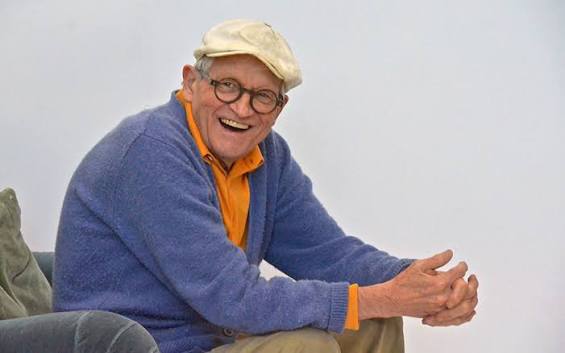
Born in Bradford in 1937, Hockney carried his Yorkshire roots with him throughout a career spanning more than seven decades. The round spectacles, the gentle burr, the bleached blond hair and — in later years — a signature flat cap made him as recognisable as any of his paintings. He was, in every sense, one of us.
His most iconic work, A Bigger Splash (1967), captured the sun-soaked optimism of 1960s California in a single, brilliant image. It became one of the most reproduced paintings of the 20th century. In 2018, his Portrait of an Artist (Pool with Two Figures) sold at auction in New York for $90 million (£70 million), setting a world record for a work by a living artist at the time.
For many Yorkshire folk, though, Hockney’s art has always been closest to home at Salts Mill in Saltaire. When entrepreneur Jonathan Silver bought the then-derelict mill in 1987, he opened the 1853 Gallery to show work by his friend and fellow Bradfordian Hockney — and the two men’s friendship gave West Yorkshire something truly special. Today the mill is home to one of the largest collections of Hockney’s art, with a permanent exhibition on the ground floor of the 1853 Gallery. Set within the UNESCO World Heritage village of Saltaire, it has long been a place of pilgrimage for art lovers from across the country, and entry remains free. For many visitors, it is where they fell in love with Hockney’s work — and where his legacy will live on most vividly.
Yet Hockney was never one to be told what to do. As an art school student, he was initially refused his diploma — partly for refusing to write an essay, insisting he should be judged on his art alone. He went on to prove the point rather magnificently.
Throughout his career he went his own way: painting figuratively when abstraction was fashionable, embracing landscape when critics said he shouldn’t, and shrugging off the naysayers with characteristic bluntness. He once made clear he “didn’t give a damn” about those who carped at his choices. Yorkshire to the last.
He leaves behind a body of work that brought joy to millions, and a city in Bradford that can rightly claim him as its own.