
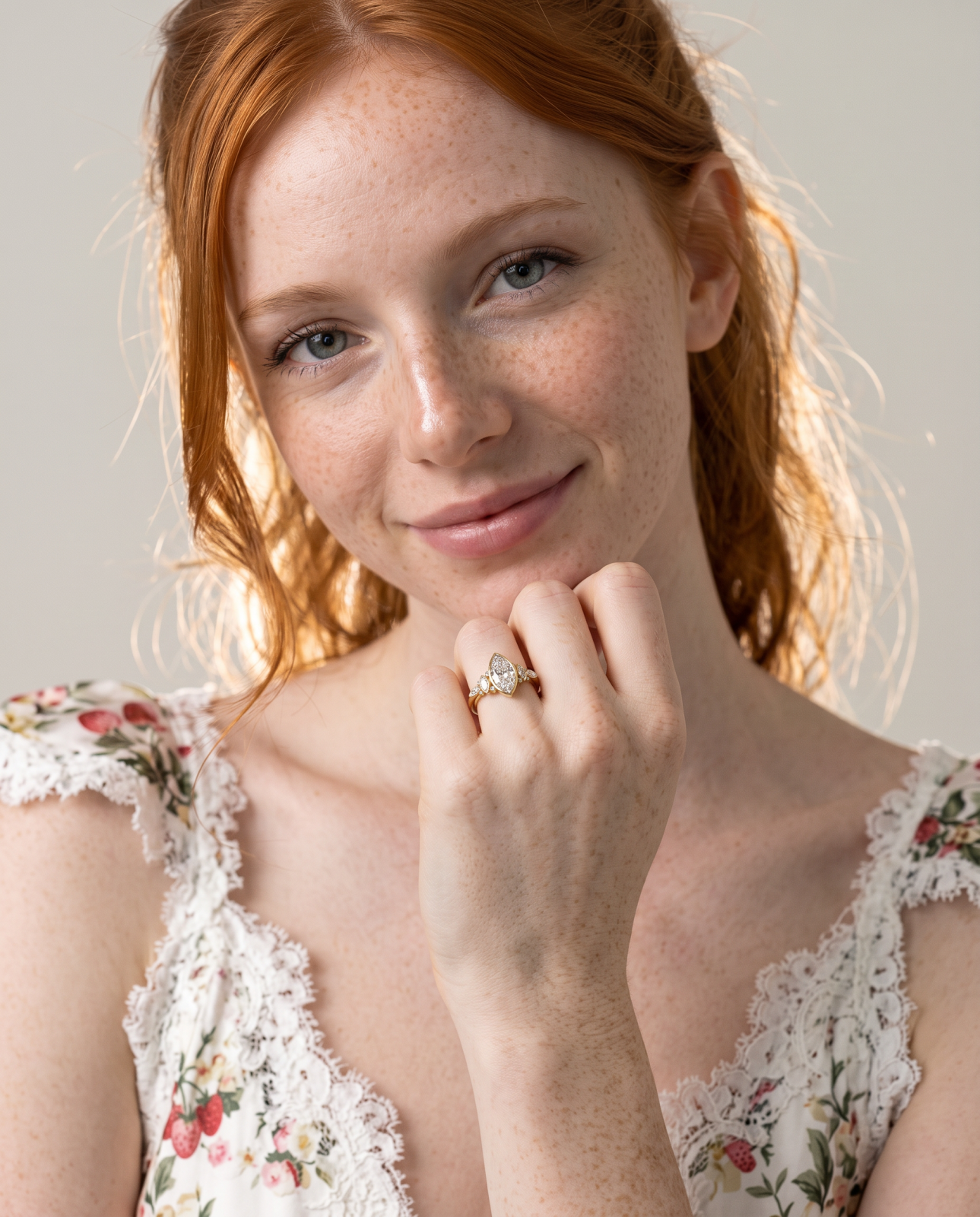
An oval diamond looks bright in one photograph, but a dark band crosses its middle in the next. Once you have spotted it, that little shape can become the only part of the ring you notice.
Known as the bow-tie effect, it is a pattern of light and dark across the centre of the diamond. Its presence alone is not a reason to reject a ring. What matters is how prominent it looks and whether the centre brightens as the stone moves.
Why the middle can look dark
A diamond’s flat, polished surfaces, called facets, reflect light from its surroundings. Your head and shoulders block some of that light when you look into it. In an oval, the resulting contrast can resemble two dark triangles meeting in the middle. The arrangement and proportions of the facets also influence how prominent that pattern becomes.
GIA’s oval diamond guide explains that bringing your face closer to the actual stone can make the effect more pronounced, because you block more of the light reaching it.
Make photographs and videos easier to compare
Start by separating the ring design from the diamond you would receive. Lily Arkwright’s collection of oval engagement rings includes lab-grown diamonds in solitaire and halo settings. The collection photographs help you compare designs, but ask which images show the particular centre stone being offered. A picture of another diamond in the same setting cannot settle the bow-tie question.
For online shopping, request a short video of the actual diamond moving slowly, with a clear view from above. A clip that spins quickly through a full rotation may be less helpful than a gentle tilt that lets you follow what happens across the centre.
Ask what lighting was used. If possible, see the diamond in daylight away from direct sun and in ordinary indoor light, as well as under jewellery-display lighting. The aim is to understand how it looks in places where you will wear it.
When comparing two candidates, ask for them together under the same light, at a similar angle and distance from the camera. Separate videos made in different setups leave you comparing the filming as well as the stones.
Keep the comparison at a sensible scale, too. A diamond filling a phone screen is useful for detail, but it cannot show how noticeable that detail will be on your hand. Request a normal-distance view alongside the close-up. Treat the footage as a reason to investigate further, rather than a guarantee of the in-person appearance.
Watch the centre as the stone moves
The useful distinction is between a dark area that breaks into bright reflections and a broad band that remains conspicuous through movement.
In GIA’s research on oval, pear and marquise diamonds, observers generally disliked bow ties that were wide, dark or persistent. Opinions varied more when the pattern was narrower, lighter or changed from dark to bright. That leaves room for personal preference; a brief flash of contrast is different from a centre you find distracting throughout a viewing.
When trying a ring, gently turn your hand and watch the middle as well as the ends. Does the whole stone seem lively, or do you keep looking at the same dark strip?
There is no need to hunt for a moment when every facet looks bright. Give yourself time to see the changing pattern.
Can the measurements tell you enough?
Length divided by width gives an oval’s length-to-width ratio: how long or broad its outline is. It does not describe all the angles and facet arrangements controlling the reflections inside.
GIA’s research highlights the complexity of these shapes. A preferred ratio, or a shortlist based on a few measurements, cannot by itself establish whether you will enjoy the bow-tie pattern. Use the measurements to find proportions you like, then assess the individual diamond in motion.
Decide before the ring is made
If a particular dark band bothers you, show the jeweller the frame or clip and explain what you are seeing. Ask to compare another stone under the same conditions. That is more useful than requesting an oval with an undefined promise of “no bow tie”.
For a ring being made to order, establish when the centre stone is selected, what viewing options are available and which return or exchange terms apply to your chosen configuration before committing.
The deciding view is the ring at an everyday distance, with a pattern of reflections you enjoy watching.