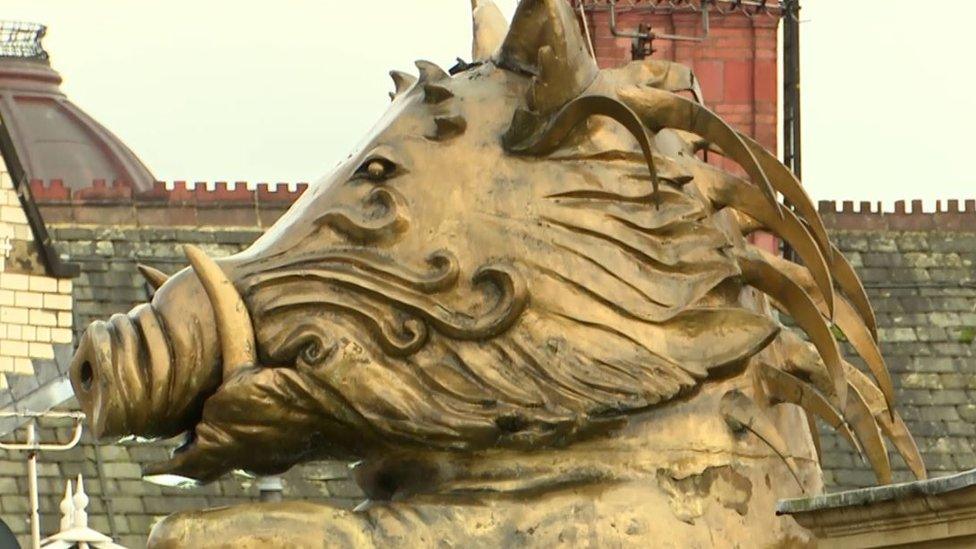
Walk through Bradford city centre and it’s everywhere. On the walls of City Hall. Crouching in gold above the doorway of a pub on Ivegate. Etched into gates, cast into drainpipes, stitched into football badges. A wild boar, rendered in stone and metal, watching over the city.
But why?
The answer takes you back to 14th-century Bradford, when much of the land was thick medieval forest owned by John of Gaunt, son of Edward III and Lord of the Manor. The woods around Cliffe Wood (where the cathedral now stands) were home to a ferocious wild boar that had been terrorising local people, blocking access to the well they depended on for water.
John of Gaunt put up a reward: kill the boar and bring him the head.
Many tried. Many failed. Until a man named John Northrop finally succeeded, killing the beast but finding its head too heavy to carry on foot. So he cut out the tongue as proof and went to claim his reward.
Then things got complicated.
A traveller passing through the forest stumbled on the dead boar. Seeing an opportunity, he loaded the head onto his horse and arrived at the Manor House before Northrop, ready to claim the prize for himself.
He was just about to receive it when Northrop walked in.
And presented the tongue.
John of Gaunt examined the boar’s head, found it tongueless, and awarded the reward, and a plot of land, to its rightful winner.
That tongueless boar’s head has sat atop Bradford’s coat of arms ever since. Look closely next time you see it. The BBC went in search of Bradfordians who knew the story and found that many didn’t, including a man who had lived in the city since 1961.
An 18-year-old Bradford College student named Falek Ahmed put it simply: “There used to be loads of boars in medieval times. Lots of the land round here was forest.” (BBC News)
She’s right. And Bradford has been honouring the man who killed one of them for nearly 700 years.
Source: BBC News