

The Renters’ Rights Act has set a firm deadline for the new national landlord register, and the clock starts with 15 December 2026. A landlord who skips registration can face a penalty of up to £7,000. About 11 million people rent privately in England, so the government wants to let every home on record.
Residential letting services can take much of the paperwork off your desk, yet every owner still needs to understand the dates, fees and documents involved. This guide sets out each regional window, the cost, the certificates you need and a simple plan to register on time.
Key Takeaways
- The rollout starts in one region and moves across England month by month.
- Each region gets a three month window, ending for everyone on 14 November 2027.
- Registration costs £65 per property annually, with no VAT.
- The maximum charge for not registering is £7,000.
- Safety certificates and an EPC should be ready before you start.
When Must Landlords Register Rental Properties in England?
Landlords must register each rental property in a three month window set by region. Registration opens on 15 December 2026 in the West Midlands and reaches Yorkshire and Humberside on 15 April 2027. The final deadline for every region is 14 November 2027.
| Region | Registration opens | Deadline |
|---|---|---|
| West Midlands | 15 December 2026 | 14 March 2027 |
| East of England | 15 January 2027 | 14 April 2027 |
| East Midlands | 15 February 2027 | 14 May 2027 |
| South East | 15 March 2027 | 14 June 2027 |
| Yorkshire and Humberside | 15 April 2027 | 14 July 2027 |
| North West | 15 May 2027 | 14 August 2027 |
| North East | 15 June 2027 | 14 September 2027 |
| London | 15 July 2027 | 14 October 2027 |
| South West | 15 August 2027 | 14 November 2027 |
Source: GOV.UK, regional rollout schedule.
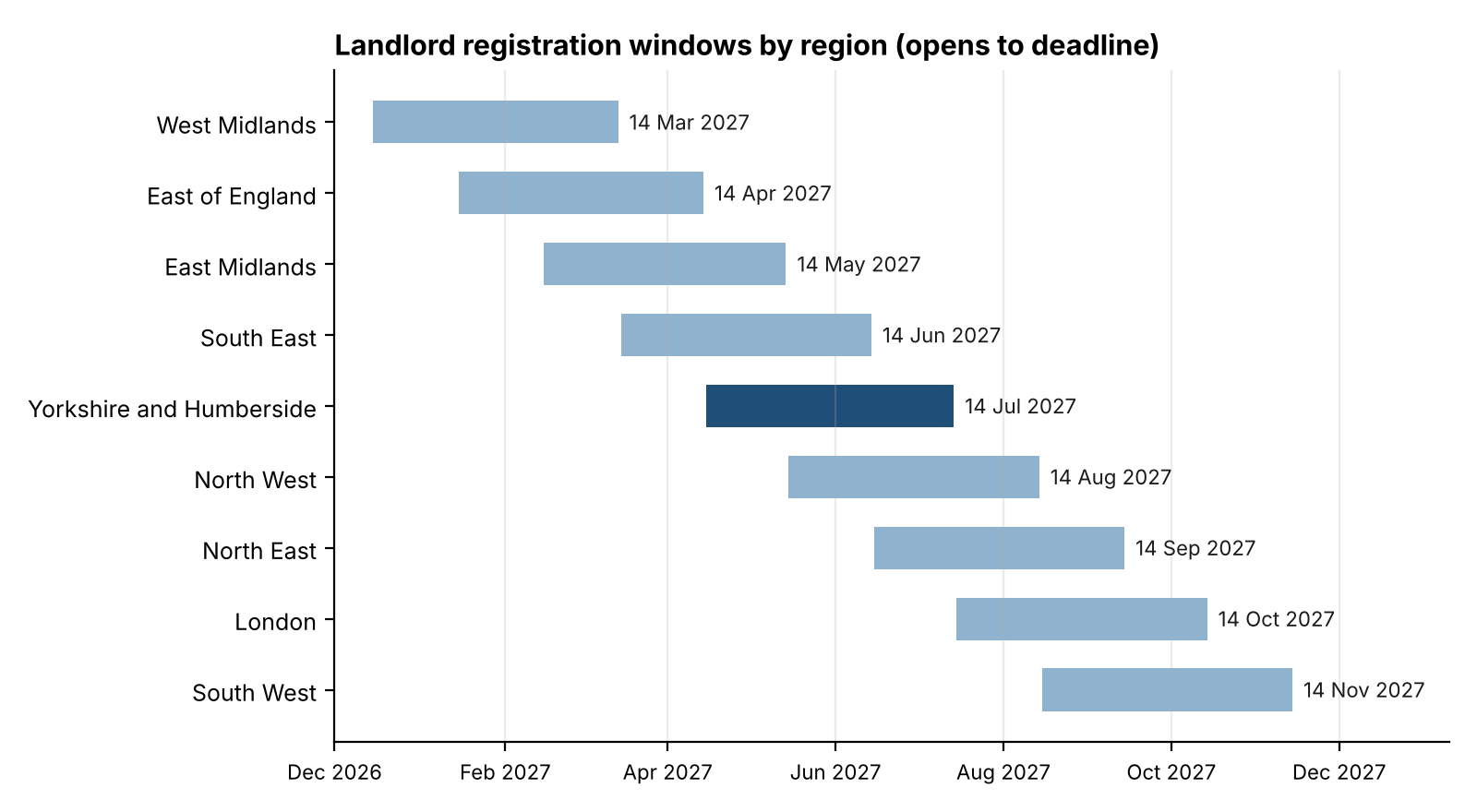
Each bar shows the three month window for one region. Yorkshire and Humberside is highlighted.
Registration follows the property’s location, so an owner with homes in two regions registers each one in its own window. Landlords in the East of England, which includes Peterborough, face the earlier deadline of 14 April 2027.
| Good to know: The dates above come from current GOV.UK guidance. Check the guidance page again before your window opens, because it is the place where any change will appear. |
Who Needs to Register a Rental Property?
Any private landlord letting a home in England under an assured or regulated tenancy must register. Companies and other organisations are included. The duty covers:
- Every landlord: you register yourself and each property you let.
- Joint landlords: each one registers separately.
- Co-owners: anyone entitled to possession registers, even without a name on the tenancy.
One exception exists for supported exempt accommodation, as defined in section 12 of the Supported Housing (Regulatory Oversight) Act 2023.
How Much Does Landlord Registration Cost?
The fee is £65 per property each year, and it carries no VAT. Registering yourself and updating records costs nothing. During the rollout the fee is pro rated, because days before 15 November 2027 are disregarded.
| Properties you let | Annual registration fee |
|---|---|
| 1 property | £65 |
| 3 properties | £195 |
| 5 properties | £325 |
| 10 properties | £650 |
Full year figures before any pro rating. Calculated from the £65 per property fee.
| Pro tip: Build the fee into your annual budget now. A portfolio of ten homes adds £650 to your yearly running costs. |
What Information Do You Need to Register?
The official registration guidance lists the details each property record needs. Collect these ahead of your regional start date:
- Property address, number of bedrooms and rental status.
- A correspondence address in England or Wales.
- Contacts for managing agents, superior landlords and freeholders.
- Gas safety certificate, where the property has gas.
- Electrical safety certificate and Energy Performance Certificate.
- Any licences, such as an HMO licence, plus your rent details.
You can send outstanding information within 28 days of registering. After that, the property registration may be deactivated.
| Pro tip: Store every certificate as a PDF in one folder. Registration takes far less time when each document is one click away. |
What Happens If You Do Not Register?
Local councils hold new powers to investigate, collect evidence and act against landlords who miss their window. The penalties are set in two tiers.
| Breach | Maximum penalty |
|---|---|
| Failing to register yourself or your property | Up to £7,000 |
| Knowingly or recklessly giving false or misleading information | Up to £40,000 |
| Continuing or repeated breaches of certain requirements | Up to £40,000 |
Source: GOV.UK, penalties for landlords.
Tenants gain extra leverage too. From the opening day, they can apply for Rent Repayment Orders in certain cases, and the First-tier Tribunal reviews each application. The maximum order has doubled from one year’s rent to two years’ rent.
| Check first: A missed deadline costs far more than the £65 fee. Diary your regional deadline today and aim to file early in your window. |
Which Renters’ Rights Act Rules Already Apply?
The Act became law with Royal Assent on 27 October 2025, and the full text runs to five parts. Its main tenancy reforms took effect on 1 May 2026. These rules already apply to your lets:
- Section 21 no fault evictions are abolished, so you need a legal ground and a section 8 notice, which generally carries four months of notice.
- Tenancies run as rolling assured periodic agreements with no end date.
- Rent rises once a year through Form 4A, with at least two months’ notice.
- You cannot encourage bidding or accept offers above the advertised rent.
- Tenants can request a pet, and you can refuse only for a valid reason.
- Landlords cannot discriminate against applicants with children or on benefits.
Courts normally grant possession when a tenant owes at least three months of rent. Shorter arrears leave the decision to the judge. A court also expects the deposit to sit in a government approved scheme, with the correct information given to the tenant.
Existing tenants should already hold the government information sheet on the new rules, which was due by 31 May 2026. Where an agreement was purely verbal, you owed them a written statement of the key terms by the same date.
Local demand shapes how these rules land in practice. Yorkshire agents continue to expand their residential lettings teams, and tenants are finding ways to stretch their rental budgets by sharing homes. The Leeds city centre property market also showed a strong start to 2026.
How Can You Prepare Before Your Window Opens?
A short checklist keeps the process calm. Work through these steps in order:
- Find your region in the table and note the deadline.
- List every property and every joint owner.
- Gather gas, electrical and EPC certificates and any licences.
- Check what each home is worth with a free property valuation so your records stay current.
- Budget £65 per property, then register in the first month of your window.
This short walkthrough shows the registration screens and the documents you need:
[Video: “Landlord Database: How to register your rental property” (September 2026) | https://www.youtube.com/watch?v=8tsB9agAdxw]
Some owners prefer a managing agent to handle the evidence trail. Progressive Lets in Peterborough manages single lets, HMOs and portfolios, and its 4.9 rating across 540 reviews reflects that focus. Its team brings more than 50 years of combined lettings experience, with quarterly photographic inspections and tenant referencing that includes Right to Rent checks.
One landlord with a rental portfolio sums up the experience:
“I’ve been using them to manage my rental portfolio and they have been exceptional from day one. Their communication is great, and knowing my properties are in expert hands gives me complete peace of mind.”
Rashed Nirob, landlord review
What You Need to Know
What is the registration deadline for landlords in Yorkshire?
The Yorkshire and Humberside window runs from 15 April 2027 to 14 July 2027. Landlords in the region have three months to register each property, and every landlord must be registered by 14 November 2027.
How much will registering a home cost?
Expect to pay £65 per property every year, with no VAT charged. Your own registration and any record updates are free. Early registrations pay for fewer days during the rollout.
What documents do landlords need to register?
You need the property address, bedroom count, rent details, a gas safety certificate where relevant, electrical safety paperwork and an EPC. Licences such as HMO licences are added where they apply.
What is the penalty for not registering?
The maximum for failing to register is £7,000. Giving false or misleading information on purpose, or through reckless disregard, can raise the maximum to £40,000.
Do joint landlords each have to register?
Yes. Each joint landlord must register, and so must any co-owner entitled to possession, even if their name is missing from the tenancy agreement.
Final Thoughts
Registration runs in nine regional windows, from 15 December 2026 to 14 November 2027, at an annual £65 per property. Yorkshire and Humberside owners have until 14 July 2027, and East of England owners until 14 April 2027. Penalties reach £7,000 for non registration.
The simplest route is to gather your certificates now, confirm your region and register soon after the window opens. A tidy file of documents turns a legal duty into a short admin task, and it leaves you free to focus on your tenants and your yields.